
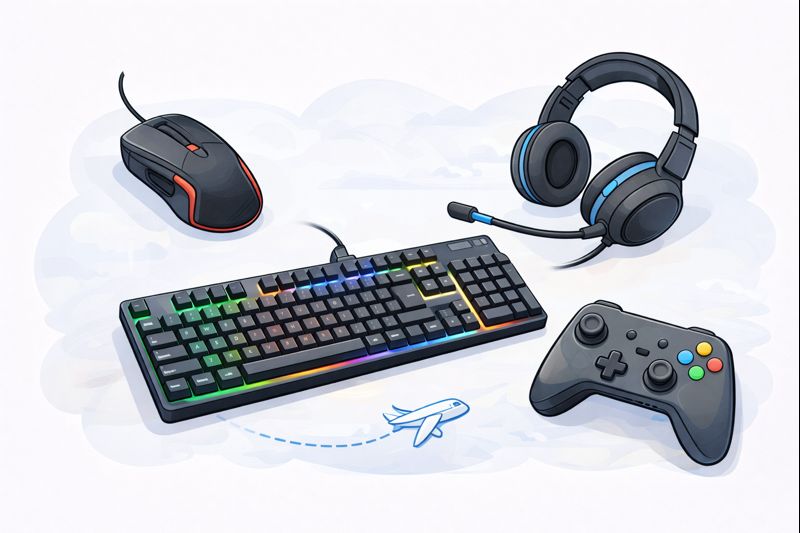
“Budget” gaming gear gets a bad reputation because people buy the wrong cheap stuff: flashy lights, weak parts, and a microphone that makes you sound like you’re calling from inside a washing machine. But if you choose by the things you actually feel while playing (shape, comfort, latency, durability), you can build a setup that performs way above its price.
Below are my practical budget picks and what to look for, plus the common mistakes I see when people try to save money.
1) Budget gaming mouse: what matters (and what doesn’t)
What matters in real life
- Shape and grip comfort (this is #1, always)
- Consistent tracking (doesn’t “spin out”)
- Decent switches + scroll wheel
- Weight you can control (light is great for FPS, but only if it feels stable)
What doesn’t matter as much
- Insane DPI numbers (most people live around 800–1600)
- RGB brightness levels that could guide ships to shore
My budget mouse picks (quick guide)
- Safest all-around: Logitech G203, SteelSeries Rival 3
- Big-hand comfort: Razer DeathAdder Essential
- Lightweight FPS feel: Cooler Master MM711, Glorious Model O, HyperX Pulsefire Haste 2
- Best budget wireless: Logitech G305/G304
- Extra buttons for the money: Redragon M711C
Pros of going budget here: Huge performance-per-dollar.
Cons: Some ultra-cheap mice feel fine for a month, then the wheel starts acting like it has opinions.
2) Budget gaming keyboard: pick your “type” first
Keyboards are where you can accidentally waste money the fastest, because “mechanical” doesn’t automatically mean “good for you.”
Choose your lane
- Mechanical (clicky/tactile/linear): best feel for most gamers, louder
- Membrane (quiet): often cheaper, can still be totally fine, especially if you share a room
What matters
- Layout you’ll actually like:
- Full-size: has numpad, bigger desk footprint
- TKL (tenkeyless): no numpad, more mouse space (my favorite for gaming)
- 60%/65%: compact, but you’ll use shortcuts for arrows/functions
- Stabilizers on big keys (spacebar, shift) so they don’t rattle like a shopping cart
My budget keyboard picks (quick guide)
- Best first mechanical (TKL): Redragon Kumara
- Compact desk setup: Royal Kludge RK61 / SK62-style 60% boards
- “Feels nicer than it costs”: Keychron C1 Pro
- Quiet + simple: HyperX Alloy Core RGB, Razer Cynosa V2, SteelSeries Apex 3 TKL
- Full-size with extras: Redragon K580
Pros: Easy to find something that fits your desk and play style.
Cons: Super-cheap “mechanical” boards can be loud and rattly. If noise matters, go membrane or budget for better switches later.
3) Budget gaming headset: prioritize comfort + mic clarity
Here’s my hot take: many “gaming” headsets sound okay, but the mic and comfort separate the winners from the bargain-bin sadness.
What matters
- Comfort for 2+ hours: clamp force, ear pad material, weight
- Mic that stays clear (friends will thank you)
- Simple connection: 3.5mm is easiest across devices; USB can be nice for PC
My budget headset picks (quick guide)
- Best comfort-for-money: HyperX Cloud Stinger 2 Core
- Great mic value: Razer BlackShark V2 X
- Balanced overall: Corsair HS55, SteelSeries Arctis Nova 1
- Cheaper “still decent” options: JBL Quantum 100/200, Turtle Beach Recon 50X
- Ultra-budget backup tier: off-brand multi-platform headsets (only if you accept the gamble)
Pros: Big “quality of life” upgrade fast.
Cons: The cheapest headsets often fail on mic quality or comfort. If you can spend a little more anywhere, spend it here.
4) Budget controller: compatibility first, then features
Controllers are sneaky because the “best” one depends on what you play on.
What matters
- Compatibility: PC, Xbox, PlayStation, Switch (not all controllers play nicely everywhere)
- Wired vs wireless: wired is cheaper + zero charging hassle; wireless is comfy for couch play
- Stick feel and reliability (drift is the enemy)
My budget controller picks (quick guide)
- Best cheap all-rounder: 8BitDo Ultimate C
- Most compatible mainstream: Xbox Wireless Controller
- Great value wired: GameSir G7 SE / GameSir T4 Kaleid
- Reliable “simple wired”: Logitech F310
- Switch budget: PowerA Enhanced Wired (Switch)
- If you’re on PS5: DualSense is still the default “it just works” pick
Pros: A good controller instantly improves platformers, sports, racing, and couch gaming.
Cons: Super-cheap controllers can have mushy buttons and questionable sticks.
The “don’t waste money” checklist (5 quick rules)
- Mouse shape > mouse specs. If it cramps your hand, it’s a bad mouse for you.
- TKL keyboards are the sweet spot for most gamers (more mouse space, still practical).
- Headset comfort is non-negotiable. If it hurts, you’ll stop using it.
- Buy the controller that matches your platform instead of forcing compatibility hacks.
- Skip the sketchy no-name brands unless you’re okay replacing it soon.
If you want the easiest budget setup that feels legit
- Mouse: Logitech G203 (wired) or Logitech G305 (wireless)
- Keyboard: Redragon Kumara (TKL)
- Headset: HyperX Cloud Stinger 2 Core
- Controller: 8BitDo Ultimate C (or Xbox Wireless Controller for max compatibility)
I