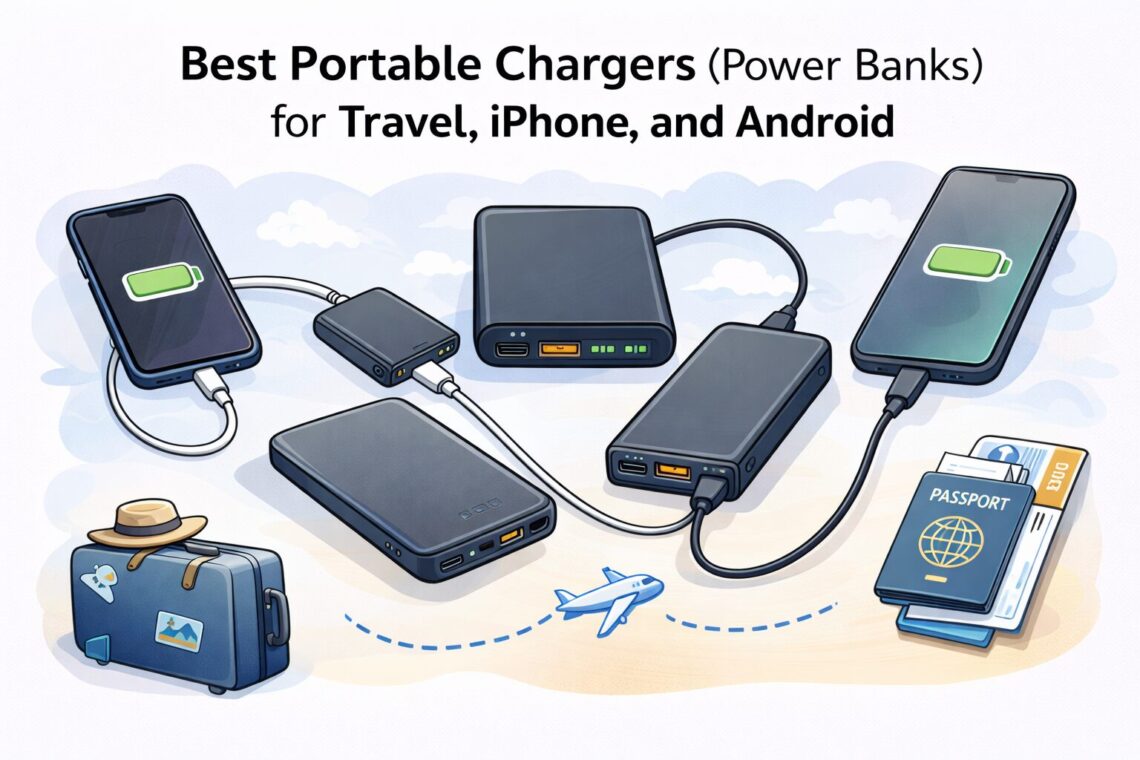
I judge power banks the same way I judge umbrellas: the one you actually carry is the one that saves you. The “monster capacity” brick that lives in a drawer is just an expensive paperweight with LEDs.
Below are picks that make sense in real life (travel, iPhone, Android, and even laptops), plus the pros/cons that usually don’t show up on the product box.
First: the travel rules you should know
For flights, power banks should go in your carry-on, and the common limit is up to 100Wh per battery without special approval; 101–160Wh may require airline approval (often limited to two spares); above that is generally not allowed. Always check the Wh rating printed on the bank.
What specs matter (the short, useful version)
- Capacity: 10,000mAh = light and easy; 20,000mAh = travel sweet spot; 24,000–25,000mAh = long trips and laptops.
- Output (watts):
- 20–30W: great for phones
- 45–65W: phones + tablets + some laptops
- 100W+: serious laptop charging
- USB-C PD + PPS (Android fast charging): If you use Samsung/Pixel and care about top speed, PPS support is a real upgrade.
- Ports: More ports = more flexibility, but also more bulk. Two outputs is the practical minimum for travel.
Best magnetic power banks for iPhone (Qi2/MagSafe-style)
1) Anker MagGo Power Bank (Qi2) 10,000mAh
Why it’s great: This is the “it just works” magnetic choice for iPhone users who want a solid snap-on charger that feels premium.
Pros
- Strong magnetic attach-and-charge convenience
- Great everyday capacity without being ridiculous
- Clean “grab and go” vibe for commuting/travel
Cons
- Wireless charging adds heat (normal, but noticeable)
- Bulks up the phone in your hand and pocket
- Not ideal if you need to charge a laptop
2) PISEN Qi2 Mag Power 10,000mAh
Why it’s great: A more affordable Qi2 magnetic option that still gives you the same basic lifestyle win: slap it on and stop thinking.
Pros
- Qi2 magnetic convenience for iPhone
- Often better value than the big-name options
Cons
- Fit/finish and long-term durability can vary more by brand
- Still suffers the universal “wireless charging = warmer” issue
My real-world tip: Magnetic banks are best for “top-ups while moving.” If you’re charging from 10% to 100% at a hotel, use a cable instead. It’s faster and cooler.
Best ultra-portable travel pick (lightweight, pocketable)
3) Nitecore Pocket 10,000mAh
Why it’s great: When you care about weight and space (one-bag travel, day trips, long walks), this style of bank is easy to justify.
Pros
- Very travel-friendly size/weight
- Enough power for a full day of phone top-ups
Cons
- Lower total capacity than chunky 20,000mAh banks
- Usually fewer ports/features than bigger models
Best all-around travel power bank (the “one bank for most people” category)
4) INIU 20,000mAh 65W
Why it’s great: 20,000mAh is the sweet spot for travel, and 65W is enough to cover phones, tablets, and many USB-C laptops in a pinch.
Pros
- Excellent capacity for long days + airports
- 65W output is genuinely versatile
- Typically strong value for what you get
Cons
- Bigger/heavier than 10,000mAh options
- Charging multiple devices can reduce speed per port
5) Belkin BoostCharge Pro 20,000mAh
Why it’s great: Belkin is the safe, mainstream pick when you want something reliable and easy to live with.
Pros
- Reliable brand with consistent build quality
- Great “giftable” option (less risk, less weirdness)
Cons
- Often pricier than similar-spec competitors
- Not the smallest for the capacity
Best for laptop charging (bring-your-own-outlet energy)
6) Anker 737 Power Bank (PowerCore 24K) 140W
Why it’s great: This is the classic “I travel with a laptop and I’m not messing around” pick.
Pros
- High wattage for laptop charging
- Big capacity for long work sessions
- Great for power users (travel + work + devices)
Cons
- Heavy. You’ll feel it in a backpack.
- Overkill if you only charge a phone
7) UGREEN 25,000mAh 145W 3-port USB-C
Why it’s great: Strong capacity + high output + multiple ports makes it a solid travel workhorse.
Pros
- Big capacity for long-haul travel
- High output for laptops
- Multiple ports = easier multi-device charging
Cons
- Bulkier than most “daily carry” banks
- You’ll want a good cable to actually hit high wattage
8) Anker Prime 20,000mAh 200W
Why it’s great: This is the “I want the fastest thing that still fits in a bag” option.
Pros
- Very high output for demanding devices
- Great if you routinely charge multiple devices fast
Cons
- Premium price
- Higher output doesn’t always matter unless your devices can use it
Best slim high-power bank (bag-friendly, not brick-shaped)
9) Baseus Blade 20,000mAh 100W
Why it’s great: Slimmer design makes it easier to pack than many high-power banks.
Pros
- Slim profile (great for backpacks and laptop bags)
- 100W class output covers a lot of laptop needs
Cons
- Still heavier than it looks
- “Slim” doesn’t mean “light”
A quick “what should I buy?” cheat sheet
- iPhone + convenience: Anker MagGo (Qi2) 10K
- iPhone magnetic on a budget: PISEN Qi2 Mag 10K
- Light travel / day bag: Nitecore Pocket 10K
- Most travelers (best balance): INIU 20K 65W or Belkin 20K
- Laptop travel / remote work: Anker 737 (140W) or UGREEN 25K (145W)
- Slim laptop-bag option: Baseus Blade 20K (100W)
One last thing: don’t ignore PPS if you’re on Android
If you have a Samsung Galaxy (especially) or other Android that supports it, PPS can mean faster charging and better efficiency than basic PD alone. When in doubt, look for “PD + PPS” in the specs.