Shopping for a phone is weird in 2026. Every box screams “pro,” every camera is “AI-enhanced,” and the spec sheet reads like a spaceship manual. Meanwhile, what most people want is simple: a phone that feels fast, takes good photos, doesn’t die at 4 pm, and won’t make them regret the purchase two weeks later.
I’ve bought phones for myself, helped friends choose theirs, and done the classic mistake of overvaluing one impressive number (hello, megapixels) while ignoring the stuff that actually affects daily life. Here’s a practical guide to what matters in real use, what’s mostly marketing, and how to choose without getting trapped by spec-sheet theater.
Start with the only question that really matters: how do you use your phone?
Before you compare chips and camera sensors, define your top two priorities:
- Photos and video
- Battery and charging
- Gaming/performance
- Small size / one-hand use
- Durability
- Price/value
You can’t max everything unless you’re buying a flagship, and even then you’ll still compromise (usually on size or price, sometimes both).
Performance: the chip matters less than you think (until it doesn’t)
What matters in real life
- Smoothness (UI performance): scrolling, app switching, and opening the camera quickly
- Sustained performance: does it stay fast after 10–15 minutes of gaming or recording video?
- Heat control: hot phones slow down and feel awful
A “faster” chip on paper doesn’t always feel faster if the phone overheats or the software isn’t optimized.
What to look for
- Reviews that test long gaming sessions and thermal throttling
- Phones with a reputation for stable performance, not just peak benchmarks
- At least 6–8 GB RAM for basic longevity (more can help heavy multitasking)
What to ignore (mostly)
- Benchmark scores as the main decision factor
- Tiny differences between flagship chips from the same year (you won’t feel it in messaging apps)
Display: refresh rate is nice, but brightness and touch response are the real heroes
What matters in real life
- Brightness in sunlight: if you can’t see your screen outdoors, nothing else matters
- Color and viewing angles: especially for photos and video
- Touch responsiveness: for typing and gaming
- Refresh rate (90/120 Hz): makes scrolling feel smoother, yes, but it’s not the whole story
What to look for
- OLED if you care about deep blacks and contrast
- High peak brightness (check real-world tests, not just advertised numbers)
- 90–120 Hz if it’s within budget (once you get used to it, 60 Hz can feel a bit “sticky”)
What to ignore (mostly)
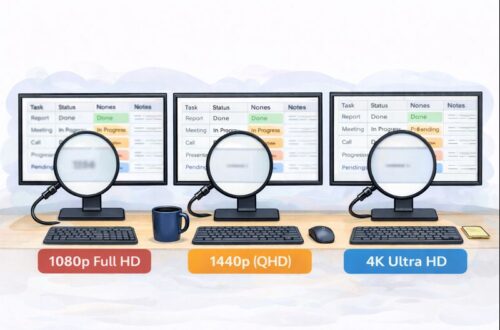
- Extreme resolution upgrades past a certain point. A good 1080p-ish OLED often looks great. You’ll notice brightness and calibration more than pixel density.
Battery: capacity is not battery life
This is the biggest spec-sheet trap. A 5000 mAh battery can still perform worse than a smaller one if the chip and screen are inefficient or the software is messy.
What matters in real life
- Screen-on time and “all-day reliability”
- Standby drain (the “why did I lose 12% overnight?” problem)
- Charging speed and how often you have to think about charging
What to look for
- Reviewers who do repeatable battery tests
- Efficient chips and well-optimized software
- Charging that fits your routine: fast top-ups vs slow overnight
Quick practical rule
If you’re out a lot, prioritize battery and charging over a slightly nicer camera. A dead phone takes zero photos.
Cameras: megapixels don’t equal better photos
Modern phone cameras are a mix of sensor quality, lens quality, image processing, and stabilization. “200 MP” looks cool on paper. In real life, you’re often using 12 MP or 50 MP binned results anyway.
What matters in real life
- Main camera consistency: good photos in normal light, not just the “perfect conditions” shots
- Low-light performance: less blur, cleaner detail, realistic colors
- Autofocus speed: especially for kids, pets, sports
- Shutter lag: does it capture the moment or the moment after?
- Video stabilization and audio: underrated, but huge for real-world video
Lenses that actually matter
- Main camera: the most important
- Ultrawide: nice for travel and groups (often worse in low light)
- Telephoto: matters if you take zoom shots often; a real optical zoom beats digital zoom every time
What to watch out for
- Phones that “over-sharpen” and over-brighten faces
- Portrait modes that cut hair like it’s doing a bad Photoshop job
- Great daytime photos but shaky low-light shots
Look at camera samples from multiple reviewers, not just the manufacturer’s gallery (which is basically the phone’s dating profile).
Storage: buy more than you think you need (especially if there’s no microSD)
Storage sneaks up on people. Photos, videos, apps, offline music, downloads… it adds up fast.
What to look for
- 128 GB minimum for most users
- 256 GB if you shoot lots of video, game, or keep your phone for years
Also consider: if your phone doesn’t have expandable storage, don’t gamble.
Connectivity: the “feels fast” features
What matters
- Reliable 5G/4G performance (depends on your area and carrier)
- Strong Wi-Fi performance (you’ll use Wi-Fi a lot more than you think)
- Bluetooth stability for earbuds and cars
A phone that drops Wi-Fi or has weak reception is miserable no matter how good the camera is.
Build quality and durability: the boring stuff that saves you money
What matters
- Water resistance (accidents happen)
- Strong glass and frame, but also… a case if you’re human
- Good haptics and buttons (you’ll feel them every day)
- Weight and balance: heavy phones can feel tiring, especially one-handed
Also: check repairability and part pricing if you tend to keep phones for years.
Software: the real “spec” that decides how long the phone stays good
This is where paper specs completely fail. A mid-range phone with excellent software support can outlive a faster phone with poor updates.
What to look for
- Clear, reliable OS update policy
- Security updates that actually arrive on time
- Features you’ll use: call screening, good photo app, customization, etc.
- Minimal bloatware (or at least removable bloatware)
If you keep phones for 3–5 years, software support should be a top priority.
The “hidden” spec: the fingerprint sensor and face unlock
Sounds small. It’s not. You unlock your phone constantly.
- A fast, reliable fingerprint sensor is a daily joy
- A bad one will make you question your life choices in public
Try it in a store if you can, or check reviews that mention real-world reliability.
A simple way to choose without going insane
Here’s my practical scoring method:
- Pick your budget.
- Make a shortlist of 3–5 phones.
- For each phone, rate (1–5) these real-life categories:
- Battery life
- Main camera consistency
- Screen brightness outdoors
- Software support
- Comfort (size/weight)
- Buy the one with the best total for your lifestyle, not the best headline spec.
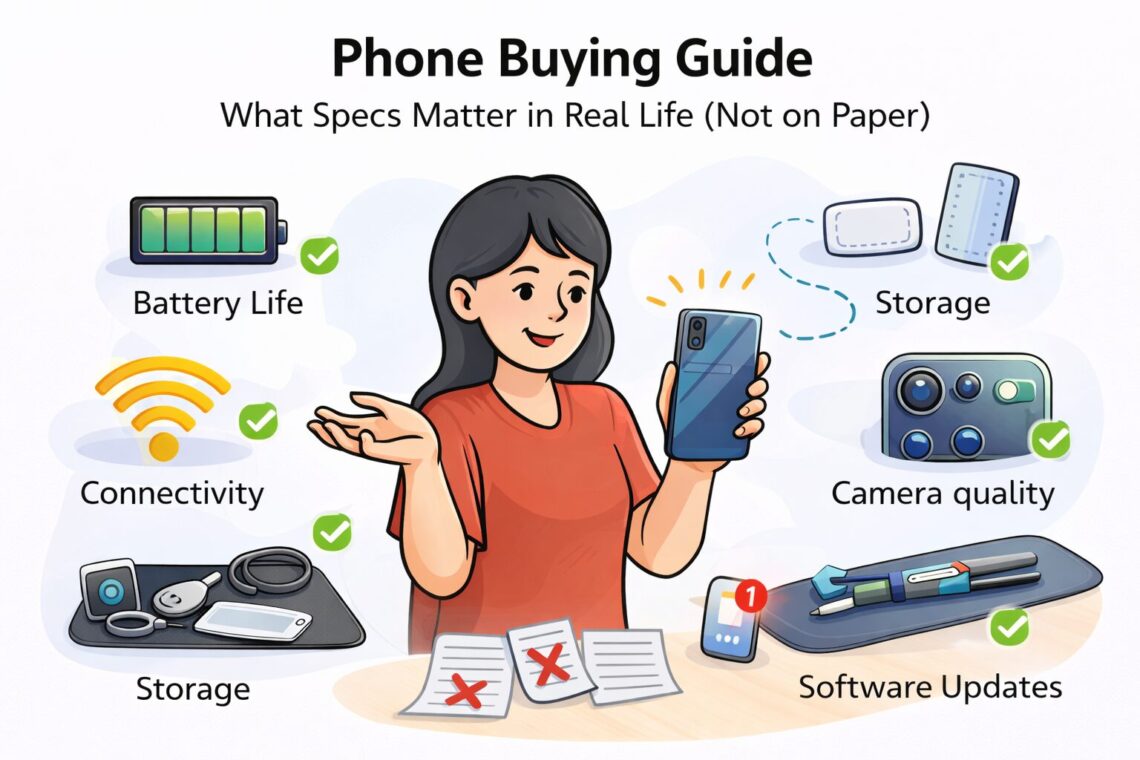
What matters most for most people
If you want the short “real life” priority list:
- Battery life + charging
- Main camera consistency (not just megapixels)
- Screen brightness and quality
- Software support and update policy
- Storage (128 GB minimum, 256 GB if you keep phones long)
Specs are useful, but only when they predict your daily experience. The goal isn’t to win a spec sheet comparison. The goal is to buy a phone that you stop thinking about because it just works.